London is an incredible city to explore, but first-time visitors can easily spend more than necessary, waste time travelling between attractions or make a few innocent mistakes along the way.
The good news? You do not need an expensive sightseeing pass, a complicated itinerary or a huge budget to enjoy London. A little local knowledge goes a long way.
From knowing where to stand on the Underground to avoiding overpriced tourist experiences, here are 30 practical do’s and don’ts to help you make the most of your visit.
London do’s and don’ts cheat sheet
Short on time? Save our quick-reference guide to London’s most important do’s and don’ts, then explore all 30 tips below.
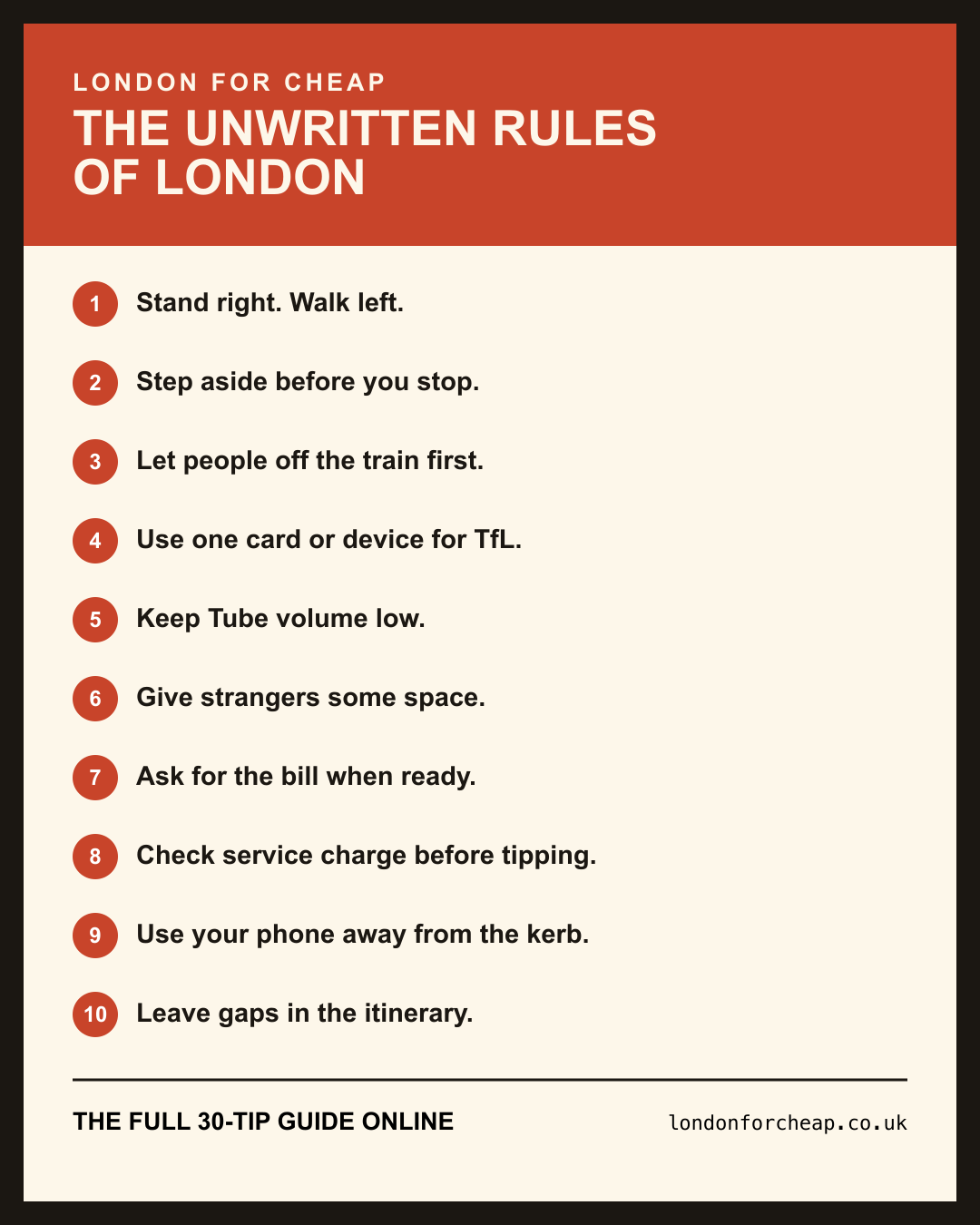
Sharing this guide with someone visiting London? Feel free to link to this page.
London’s unwritten rules
1. DO use contactless payment on public transport
You do not necessarily need an Oyster card when visiting London. Most adults can use a contactless bank card, Apple Pay or Google Pay on the public transport network.
On the Underground, tap in at the beginning of your journey and tap out at the end. On buses, tap only when boarding. Always use the same card or device: TfL treats a phone and its linked physical card as separate payment methods. Check foreign transaction fees with your bank before travelling. Our Oyster or contactless guide explains the exceptions for children, Railcards and concessions.
2. DON’T stand on the left side of escalators
The important unwritten rule is simple: stand on the right, walk on the left. If you are travelling in a group, leave room for people to pass.
3. DO take London’s red buses
Double-decker buses are an affordable way to see streets and neighbourhoods as you travel. Sit upstairs at the front for a good view when a seat is available.
TfL’s Hopper fare allows additional bus and tram journeys within one hour of the first touch-in for the price of one fare, provided you use the same payment method. Check TfL’s current bus and tram fare rules before travelling.
4. DON’T automatically take the Tube everywhere
The Underground is convenient, but it is not always quickest. Some central stations are surprisingly close: Leicester Square and Covent Garden are only a few minutes apart on foot. Check a walking route before heading underground and you may save time, money and discover something along the way.
5. DO wear comfortable walking shoes
London is best explored on foot, and distances between museums, parks, markets and attractions add up quickly. Bring shoes you have already worn in, plus clothing that works in changeable weather.
Tourist mistakes that cost money
6. DON’T assume sightseeing buses are good value
Hop-on hop-off buses can be expensive. Regular TfL buses are often a much cheaper alternative, although they do not provide a dedicated route or recorded commentary. Compare the cost before booking, especially if a guided overview is not essential. Our guide to the best London bus routes for sightseeing shows where an ordinary fare can still deliver the views.
7. DO visit London’s free museums
London has many world-class museums with free general admission to permanent collections. The British Museum, Natural History Museum, V&A, National Gallery, Tate Modern and Imperial War Museum London are strong starting points. Temporary exhibitions and special experiences can cost extra, and some museums recommend booking a free entry ticket in advance. See our guide to London’s best free museums before you go.
8. DON’T pay for something you can experience for free
You can watch the Changing of the Guard without paying for a guided tour, enjoy Tower Bridge from the riverside, walk through Royal Parks and admire Westminster Abbey from outside. Paid entry can still be worthwhile when it includes areas you want to see, but check what is free first.
9. DO watch out for tourist scams
Busy tourist areas can attract people looking to take advantage of visitors. Avoid games such as the three-cup trick, which are designed to make you lose money. Be cautious about unsolicited items or services that may later come with a demand for payment. If something feels suspicious, walk away.
10. DON’T take a pedicab without checking the fare
Pedicabs can look like a fun way to travel through the West End, but fares for short trips can be high. Agree the full fare before accepting a ride and check TfL’s current pedicab information, as regulation is changing. Walking, buses and the Underground are usually cheaper.
Getting around without looking like a tourist
11. DO queue properly
Respect the queue at attractions, cafés and bus stops. At bus stops the line can be informal, but it is polite to let people who arrived first board first.
12. DON’T block Underground doors
Let passengers leave before boarding and avoid standing directly in front of the doors. Once inside, move down the carriage when possible. Take a large backpack off and hold it by your feet, and offer priority seats to passengers who need them.
13. DO say please, thank you and excuse me
Simple courtesy helps in crowded places. Say please when ordering, thank you when somebody helps and excuse me when moving through a crowd. You will hear a lot of people saying sorry too.
14. DON’T assume every restaurant requires a tip
Many restaurants add a discretionary service charge, commonly around 12.5%, to the bill. Check before adding anything extra. When a service charge has already been included, there is generally no need to tip again. Tipping is not usually expected for drinks ordered at a pub bar or for takeaway food.
15. DO understand how London pubs work
In a traditional pub, you often order drinks and food at the bar rather than waiting for table service. If you are ordering food, you may need your table number. Some pubs use table service or app ordering, so check when you arrive. Alcohol-free drinks, soft drinks and food are normal choices too.
Small things visitors wish they knew
16. DON’T walk around holding your phone carelessly
Phone theft happens in busy central areas. Thieves may use bicycles or mopeds to snatch a phone from somebody close to the road. Step away from the kerb before checking directions and keep valuables secure on public transport and in crowded places. The Metropolitan Police’s theft advice has current reporting and prevention guidance.
17. DO look both ways before crossing the road
Vehicles drive on the left in the UK. Follow pedestrian signals and look both ways, especially near cycle lanes, bus lanes and one-way streets. Some crossings have directions painted on the road.
18. DON’T rely on perfect weather
Sun, cloud and rain can arrive in one afternoon. Pack layers and a lightweight waterproof. On a wet day, free museums and galleries make excellent alternatives; our rainy-day guide has more ideas.
19. DO carry a little cash, but don’t exchange too much
London is increasingly cashless and most shops, restaurants and attractions take cards, with some accepting cards only. A small amount of cash can still be useful, but you do not usually need to exchange a large sum. If you need cash, use a bank-operated ATM where possible and check withdrawal and exchange fees.
20. DON’T forget your UK plug adapter
The UK uses Type G sockets. Bring a suitable travel adapter and check your charger’s voltage label. Devices designed only for a lower voltage may need a converter, not just an adapter. Take particular care with high-powered appliances such as hairdryers.
Enjoying London properly
21. DO explore London neighbourhood by neighbourhood
London is enormous, so group sights by area instead of crossing the city repeatedly. Westminster works well for Big Ben, Parliament, Westminster Abbey, Buckingham Palace and St James’s Park. South Bank combines riverside walks, Tate Modern and Shakespeare’s Globe. South Kensington brings together the Natural History Museum, V&A, Science Museum and Hyde Park.
22. DON’T overplan every minute
It is impossible to see everything in one trip. Choose one or two main activities each day and leave room for a garden, independent shop or quiet street you did not expect to find. A flexible itinerary is usually more enjoyable than a packed one.
23. DO book popular attractions in advance
Free does not always mean walk-in. Sky Garden’s free public tickets are limited and booking is recommended; its official booking page currently explains its free-access times and availability. Popular paid attractions, theatre and special exhibitions can sell out too. Book the things that matter most, but leave some open time.
24. DON’T eat exclusively around major tourist attractions
Restaurants immediately beside famous landmarks are not always the best value. Check menus, prices and recent reviews, then try a few streets away. Food markets, lunch specials and weekday offers can help you eat well for less. Browse Food Deals for current affordable places to eat and restaurant offers.
25. DO leave time to discover London beyond the landmarks
Big Ben, Buckingham Palace and Tower Bridge are famous for good reason, but London has more to offer. Explore Hampstead Heath, Greenwich, independent shops, parks, riverside walks, lesser-known museums and neighbourhood markets. Many of the best discoveries cost little or nothing. Our free self-guided walks are an easy way to start.
26. DON’T stop suddenly on a busy pavement
London pavements are not a Formula One circuit, but they do have a rhythm. If you need to check a map, take a photograph or have a group discussion about lunch, step to one side first. The middle of Oxford Street, a station exit or the top of an escalator is not the place for an emergency conference.
27. DO give people space on an almost empty Tube
On a packed train, everyone is simply doing their best. On an almost empty train, sitting directly beside a stranger can feel oddly intimate. Pick another seat when one is available, keep bags out of the aisle and save the loud speakerphone call for somewhere else.
28. DON’T mistake silence for unfriendliness
London public transport is not usually a group chat. People read, listen, stare into the middle distance and avoid eye contact before coffee. It is perfectly fine to ask for help, but the default is quiet, not hostile.
29. DO avoid Covent Garden station when the stairs are the surprise
Covent Garden station has 193 steps between platform and street when lifts are unavailable or queues are managed. Check the lift status and consider walking from Leicester Square if you can. Your legs, luggage and travelling companions may all be grateful.
30. DO ask for the bill when you are ready
In many London restaurants, staff will not bring the bill until you ask. It is not neglect; it is the usual way of giving you time at the table. A simple “Could we have the bill, please?” does the job. Check whether service has already been added before paying.
London Do’s and Don’ts: Quick Checklist
Before your trip, remember these essentials.
| DO | DON’T |
|---|---|
| Use contactless public transport | Buy an Oyster card automatically |
| Stand on the right on escalators | Block the left side |
| Explore London on foot | Assume every journey needs the Tube |
| Visit free museums | Pay without checking free options |
| Book your must-see attractions | Schedule every minute |
| Keep your phone secure | Hold it carelessly beside the road |
| Check restaurant bills | Automatically add a second tip |
| Explore different neighbourhoods | Stay exclusively around tourist hotspots |
| Step aside before stopping | Halt in the middle of a pavement |
| Check Tube lifts and stairs | Discover Covent Garden’s steps by accident |
Useful official sources
- TfL fares and contactless travel
- TfL bus and tram fares
- TfL pedicab information
- Metropolitan Police personal robbery advice
- Sky Garden booking information
Explore more London guides
Planning a bigger visit? Read our guide to booking London attractions in advance, find free events in London or use the London day planner to organise your route.
For stranger detours between the landmarks, see London’s Hidden Secrets.
Enjoy London without spending a fortune
London has a reputation for being expensive, but some of its best experiences are completely free. With a little planning, you can explore world-famous museums, beautiful parks, historic neighbourhoods and riverside walks without spending much.
The secret is knowing where to look, understanding how the city works and avoiding unnecessary tourist expenses. London For Cheap helps visitors and Londoners find free events, affordable things to do, restaurant offers and practical ways to enjoy the capital for less.